

 I see many buyers feel unsure when they compare lifting magnets. The name sounds simple, but a wrong choice can slow work and create risk.
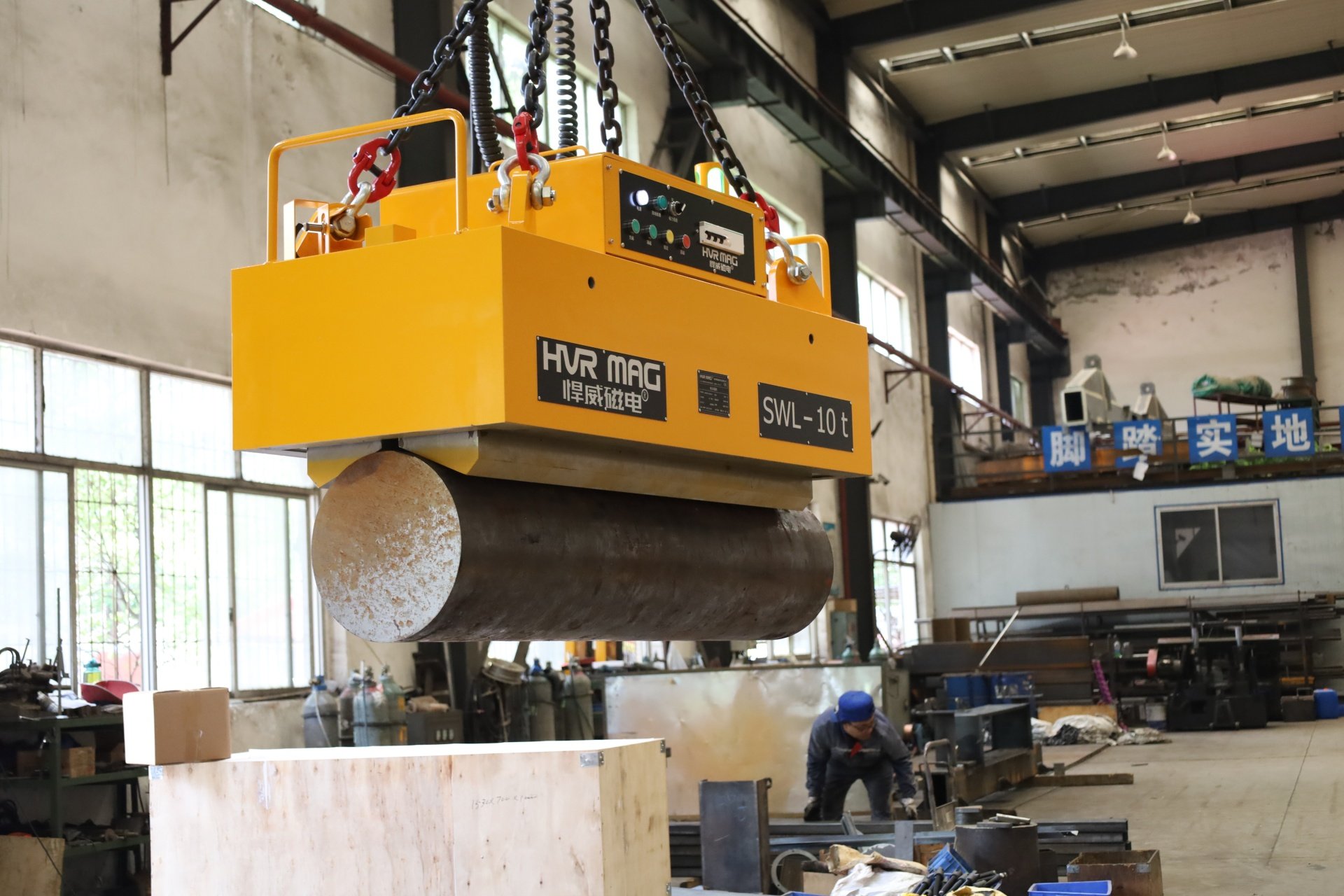
An electro-permanent magnet is a lifting magnet that uses short electric pulses to switch its magnetic state on or off1. It does not need continuous power to keep holding after magnetization.2 I explain it as a controlled magnetic system, not just a permanent magnet with a power cable.
I often meet buyers who ask one direct question first. They ask, “Is this an electromagnet or a permanent magnet?” I usually say it sits between the two in daily use, but it should not be judged only by the name. I need to look at the material, the lifting process, the power condition, and the release method. I also need to look at how often the operator picks and releases steel. That is where the real answer starts.
Как работает электропостоянный магнит
I know the word can sound technical, and that can make the buying process harder. If I explain it poorly, the buyer may expect the wrong safety behavior.
An electro-permanent magnet works by using electricity to change the magnetic state. After the magnet is switched on, the holding force is maintained by permanent magnetic force, not by continuous electric power.
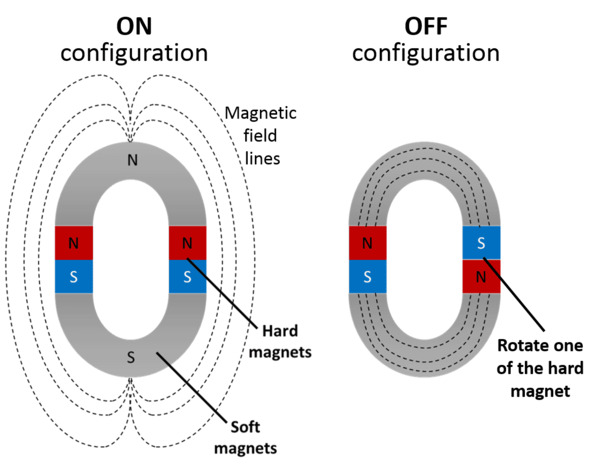
How I explain the basic logic
| Point I check | Simple meaning |
|---|---|
| Power use | I use electricity mainly for switching on and switching off. |
| Holding state | I do not need continuous power to keep the load held after magnetization. |
| Release state | I use a pulse to change the magnetic circuit and release the steel. |
| Control method | I usually control it by button, pendant, PLC, or a matched control cabinet. |
| Main value | I get fast pick and release with lower running power in many steel handling tasks. |
I explain the working idea in a very practical way. I tell buyers that the system has magnetic material inside, and the control unit sends a short electrical pulse to change the magnetic path. When the magnet is in the holding state, the magnetic force goes through the steel load. When the magnet is in the release state, the magnetic path changes, and the steel can be separated. I do not describe it as a normal permanent magnet with an electric switch, because that can create a wrong picture. The control is not just a handle moved by electricity. The whole magnetic circuit is designed around switching states. This matters in a workshop because the operator wants stable holding, quick release, and clear control. I also remind buyers that the steel must be suitable for magnetic lifting. If the steel surface has thick rust, paint, oil, scale, or uneven contact, the real holding result may change.
How Is It Different From an Electromagnet?
I often see buyers compare these two first. The names both include electricity, so the difference can look small at first.
An electromagnet normally needs continuous electric power to maintain magnetic force.3 An electro-permanent magnet uses electric pulses to switch states and does not rely on continuous power to keep holding after it is switched on.
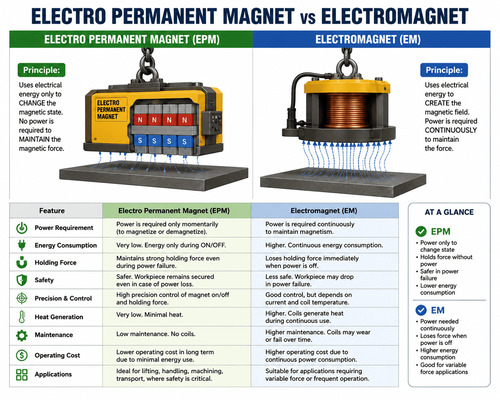
What I compare in pre-sales talks
| Item I compare | Electromagnet | Electro-permanent magnet |
|---|---|---|
| Holding power | I usually need continuous power. | I need power mainly for switching. |
| Power-off behavior | I must pay close attention to power loss risk. | I expect it to keep its magnetic state after switching. |
| Heat | I may see heat from continuous current. | I usually see less heat from holding. |
| Control | I control current during lifting. | I control magnetic state changes. |
| Common use | I may use it where strong active magnetic control is needed. | I may use it for frequent pick and release of suitable steel. |
I do not tell every buyer that one is better than the other. I think that would be too simple. An electromagnet can be a good choice in some handling systems, especially when the process already has strong power supply and the magnetic force needs active control during use. But I also point out the clear difference in power logic. An ordinary electromagnet depends on current to keep magnetism. If current stops, the holding condition changes.4 For this reason, buyers often ask about backup power, safety design, and control failure. With an electro-permanent magnet, I explain that the holding state is not maintained by continuous current after magnetization. That can reduce running power and heat in many jobs.5 It can also make frequent lifting more convenient. Still, I do not ignore application limits. The magnet still needs correct selection, correct contact, and correct operation. If the air gap is too large, or if the plate is badly warped, the result can be poor.
How Is It Different From a Manual Permanent Lifting Magnet?
I hear this misunderstanding very often. Some buyers think an electro-permanent magnet is only a manual permanent lifting magnet with electric control added.
A manual permanent lifting magnet usually uses a hand lever to change the magnetic circuit.6 An electro-permanent magnet uses an electrical control system to switch magnetic states, so the control method, operation speed, and use scenarios are different.
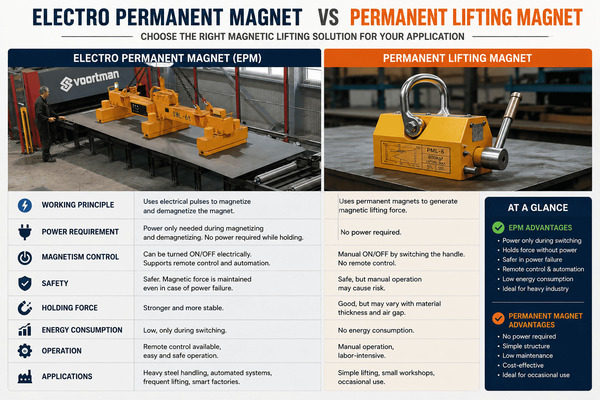
Where I see the real difference
| Item I compare | Manual permanent lifting magnet | Electro-permanent magnet |
|---|---|---|
| Switching method | I move a manual handle. | I send an electric pulse. |
| Work speed | I depend on manual operation. | I can support faster repeated cycles. |
| Operator position | I often need the operator close to the load. | I can often control it from a safer or more convenient position.7 |
| System use | I use it as a simple single tool. | I can connect it with crane control or automation. |
| Best fit | I use it for simple and less frequent lifts. | I use it when repeated pick and release is important. |
I do not want buyers to treat both products as the same family with only a different switch. I explain that the manual permanent lifting magnet is simple, strong in the right job, and easy to understand. It can work well when the load is small enough, the lift is not too frequent, and the operator can safely use the handle. But when the work requires many pick-and-release cycles, the manual handle can become slow. It can also put the operator near the steel more often. An electro-permanent magnet gives another kind of control. I can use buttons, a pendant, remote control, or a control cabinet. In some systems, I can also work with a crane or production line logic.8 This does not mean it is always the right choice. It means I should match the lifting principle to the real work. I also need the buyer to confirm plate size, thickness, flatness, and surface condition before I suggest a solution.
When Is an Electro-Permanent Magnet a Good Fit?
I see many buyers jump to price first. That can be risky because the cheapest lifting principle may not match the daily work.
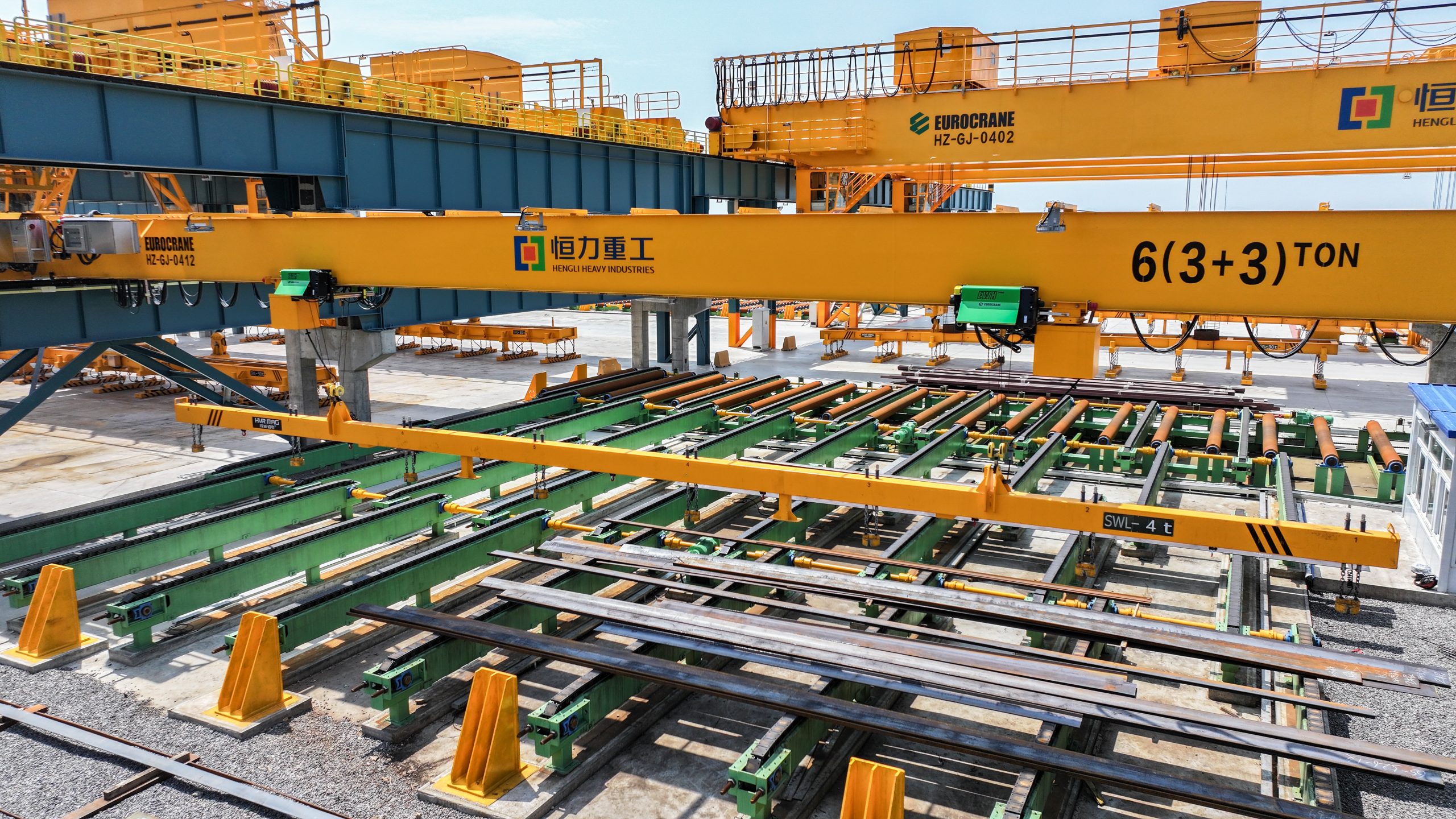
An electro-permanent magnet is often a good fit when steel parts need frequent picking, moving, and releasing, and when the material has reliable magnetic contact with the lifting surface.
The working conditions I ask about
| Question I ask | Why I ask it |
|---|---|
| What material do I need to lift? | I need magnetic material, usually steel or similar ferromagnetic material. |
| What are the size and thickness? | I need enough contact area and enough magnetic path. |
| How flat is the surface? | I need close contact to reduce air gap. |
| How often does the operator lift? | I need to judge cycle speed and control value. |
| Is the surface rusty, coated, or oily? | I need to estimate loss from poor contact. |
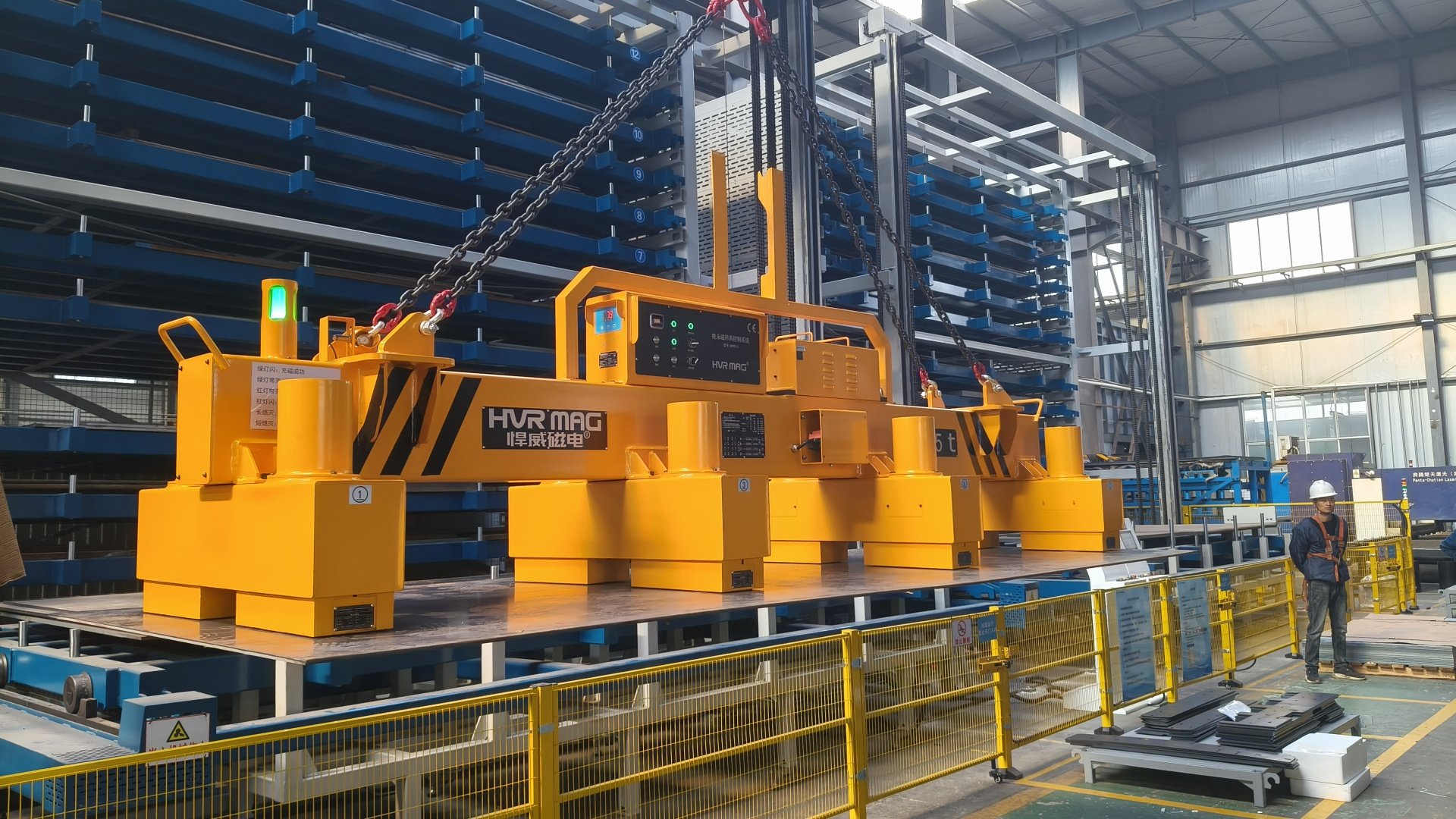
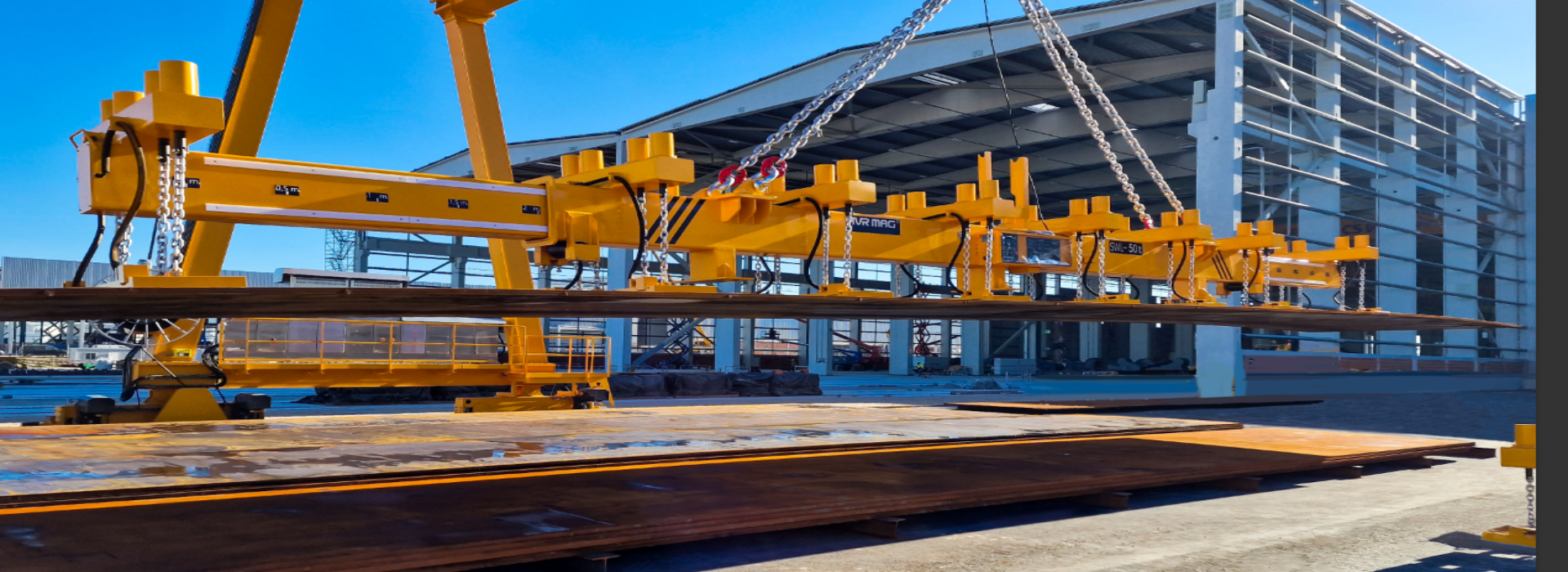
I usually see electro-permanent magnets considered in steel structure plants, steel mills, shipyards, wind power manufacturing, aviation metal processing, and general metal fabrication9. These buyers often move plates, profiles, cut parts, or welded pieces. The value is not only lifting force. The value is also faster operation, less manual contact, and easier control during repeated work. If the worker must pick one plate, move it, release it, and repeat the same action many times, the control method becomes very important. I also ask about the crane, the power supply, the lifting height, the work rhythm, and the release point. A lifting magnet is not separate from the whole workflow. It is part of the handling method. I also keep my advice bounded. If the material is non-magnetic, or if the steel is too thin, too uneven, too rusty, or heavily coated, I cannot assume a good result. I need details before I give a selection.
What Limits Should I Check Before Choosing One?
I always slow the discussion down at this point. A magnet may look strong on paper, but poor contact can reduce real performance.
I should check material type, surface condition, air gap, rust, coating, oil, thickness, flatness, and load shape before choosing an electro-permanent magnet. These factors decide whether the magnet can hold the steel reliably.
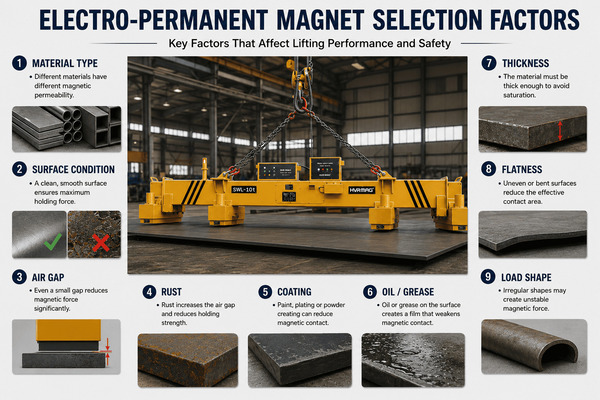
The limits I do not ignore
| Limit I check | What can happen |
|---|---|
| Air gap | I may lose holding force when the magnet cannot touch the steel well. |
| Rust or scale | I may get unstable contact and weaker holding. |
| Paint or coating | I may increase the gap between magnet and steel. |
| Thin material | I may not get enough magnetic path. |
| Uneven plate | I may get partial contact only. |
| Non-magnetic material | I cannot rely on magnetic lifting. |
I tell buyers that magnetic lifting is a contact-based solution10. I can have a well-designed electro-permanent magnet, but the lifting result still depends on the steel. A smooth, flat, clean steel plate is easier to lift than a bent, rusty, painted, or heavily scaled plate. The reason is simple. The magnet needs magnetic contact. If there is a gap, the magnetic force drops.11 If the load has only a small contact area, the force may not spread well. If the plate is thin, the magnetic path may not be enough.12 If the surface is rough or curved, only part of the magnet face may work. I also ask about whether the load is a single sheet or a stack, because this affects the handling plan. I do not promise that one magnet can solve every shape. I prefer to get drawings, sizes, photos, and working videos when possible. Then I can suggest a safer and more practical selection.
How Should I Compare the Three Lifting Principles?
I often need to help buyers choose between three options. If I compare only price, I may miss safety, power, speed, and labor cost.
I compare electromagnets, manual permanent lifting magnets, and electro-permanent magnets by power-off behavior, energy use, control method, lifting frequency, operator distance, and material condition.
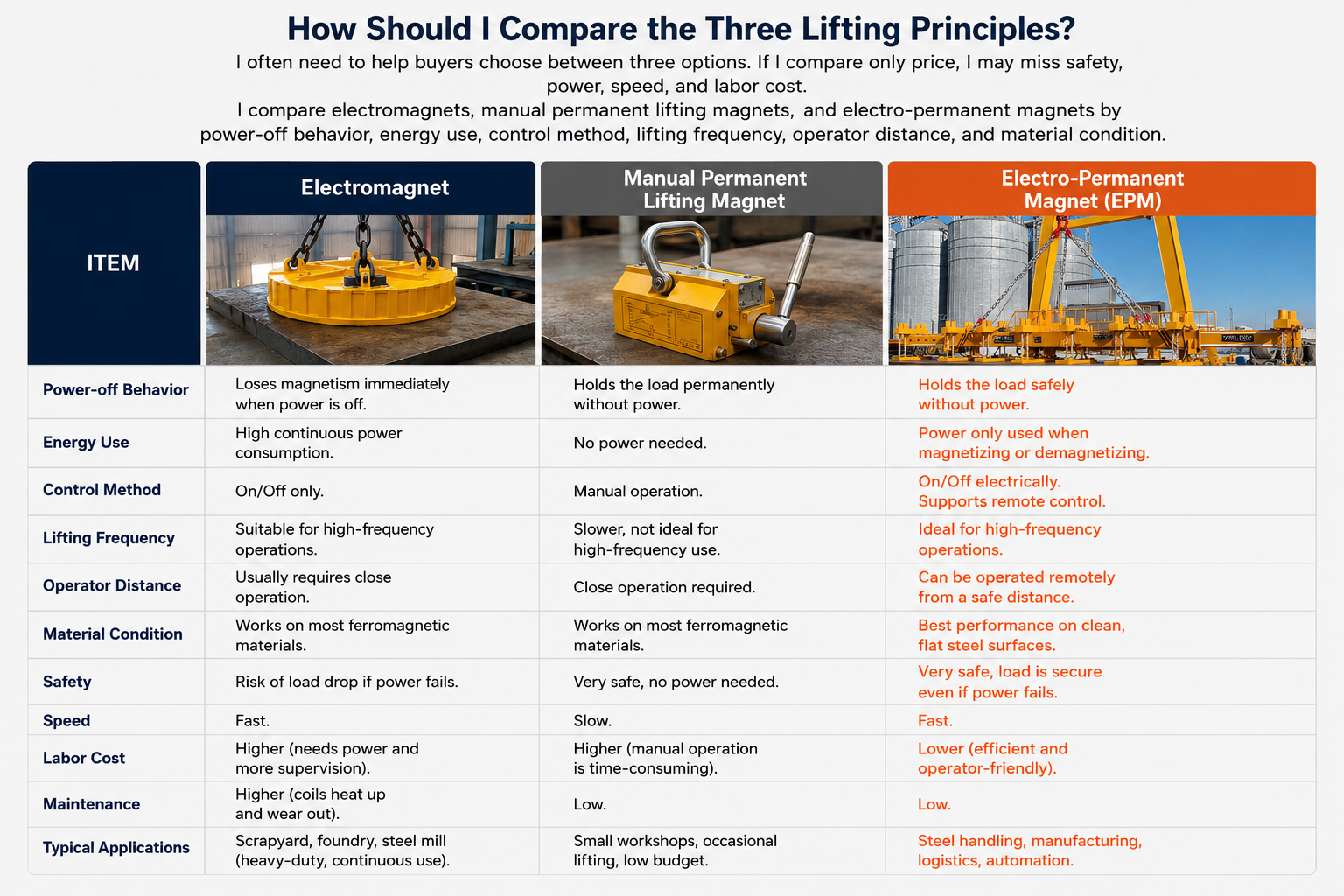
My simple comparison table
| Factor I compare | Electromagnet | Manual permanent magnet | Electro-permanent magnet |
|---|---|---|---|
| Power during holding | I usually need continuous power. | I do not need power. | I need power mainly for switching. |
| Switching | I control electric current. | I move a handle. | I send electric pulses. |
| Frequent cycles | I can use it, but energy and heat may matter. | I can use it, but manual work may slow the process. | I often consider it for repeated cycles. |
| Operator effort | I depend on system design. | I need manual handle action. | I can reduce manual switching work. |
| Application limit | I still need magnetic material and correct design. | I still need proper contact and load shape. | I still need proper contact and load shape. |
I use this comparison because buyers often ask, “Which one is safest?” I answer with care. Safety is not only the magnet type. Safety also depends on correct selection, correct rated capacity, correct operation, good contact, and the whole lifting process. An electro-permanent magnet has a strong point because it does not need continuous power to keep its holding state after magnetization. That power logic can be useful. But I do not say it is always safer in every job. A manual permanent magnet can be very reliable in simple lifts. An electromagnet can be suitable in systems that are designed for it. The best choice depends on the real work. I need to know if the buyer lifts one plate at a time, multiple parts, round steel, cut parts, or welded assemblies. I need to know if release must be fast and clean. I also need to know if the operator needs remote control. Only then can I help compare the three options in a useful way.
Заключение
I see an electro-permanent magnet as a controlled magnetic lifting system. I choose it only after I check power logic, workflow, material, contact, and safety needs.
"Electropermanent magnet - Wikipedia", https://en.wikipedia.org/wiki/Electropermanent_magnet. A neutral technical reference on electro-permanent magnets supports that these devices use brief electrical pulses to switch the magnetization state of their magnetic circuit. Evidence role: definition; source type: encyclopedia. Supports: The source should define electro-permanent magnets as devices whose magnetic state is switched by brief electrical pulses rather than continuous energization.. ↩
"[PDF] Electropermanent Magnetic Connectors and Actuators - MIT CBA", https://cba.mit.edu/docs/theses/10.06.knaian.pdf. Research literature on electro-permanent magnet actuators supports that the magnetic state is retained after a switching pulse, allowing the device to maintain magnetic force without continuous power input. Evidence role: mechanism; source type: research. Supports: The source should support that electro-permanent magnets retain their on or off magnetic state after a switching pulse, so continuous current is not required during holding.. ↩
"Magnetic field - Wikipedia", https://en.wikipedia.org/wiki/Magnetic_field. An educational physics reference supports that a conventional electromagnet produces its magnetic field through electric current in a coil, so maintaining the field normally requires continued current flow. Evidence role: definition; source type: education. Supports: The source should explain that an electromagnet produces a magnetic field when electric current flows through a coil, and that the field depends on that current.. ↩
"Loss of Field After Turning off Magnet Current - Physics Van", https://van.physics.illinois.edu/ask/listing/29482. A physics or engineering reference supports that an electromagnet’s field is generated by current flow and diminishes when the current is interrupted, which explains why the holding condition changes after power loss. Evidence role: mechanism; source type: education. Supports: The source should support the physical mechanism that an electromagnet’s magnetic field depends on current and therefore changes when current is interrupted.. Scope note: This supports the physical mechanism, while the exact lifting outcome depends on the lifting system, residual magnetism, backup power, and safety controls. ↩
"Electropermanent magnet - Wikipedia", https://en.wikipedia.org/wiki/Electropermanent_magnet. Engineering literature on electro-permanent magnetic systems supports that limiting electrical input to switching pulses can reduce continuous power consumption and resistive heating relative to conventional electromagnets. Evidence role: general_support; source type: paper. Supports: The source should support that electro-permanent magnets consume power mainly during switching and can reduce continuous electrical losses and coil heating compared with continuously powered electromagnets.. Scope note: This is contextual support; the magnitude of power or heat reduction depends on magnet design, duty cycle, controller efficiency, and the specific lifting process. ↩
"Hand Operate Magnet Tool Double Circuit Permanent Lifting ...", https://juyingqz.en.made-in-china.com/product/BnWRpkDrgcUO/China-Hand-Operate-Magnet-Tool-Double-Circuit-Permanent-Lifting-Magnet.html. A technical reference on permanent lifting magnets supports that manual models commonly use a lever-operated magnetic circuit to switch between holding and release conditions. Evidence role: definition; source type: other. Supports: The source should describe manual permanent lifting magnets as devices that use a mechanical handle or lever to alter the magnetic circuit for attachment and release.. Scope note: This supports the general operating principle; individual designs may use different mechanical arrangements. ↩
"1926.1425 - Keeping clear of the load. | Occupational Safety ... - OSHA", http://www.osha.gov/laws-regs/regulations/standardnumber/1926/1926.1425. Government lifting-safety guidance supports the general principle that workers should be kept clear of suspended loads, providing context for why remote or pendant control can improve operator positioning. Evidence role: general_support; source type: government. Supports: The source should support the safety principle that workers should remain clear of suspended loads and that control methods can affect operator positioning.. Scope note: This is contextual support; it does not prove that every electro-permanent magnet installation is safer, because safety depends on the full lifting system and work procedure. ↩
"The Construction of a Soft Gripper Based on Magnetorheological ...", https://arxiv.org/html/2407.13477v1. Research on electro-permanent magnetic grippers and lifting systems supports that electronically switched magnetic devices can be integrated into automated handling or crane-control architectures. Evidence role: case_reference; source type: research. Supports: The source should document electro-permanent magnetic grippers or lifting systems being controlled electronically and integrated into automated handling systems.. Scope note: This is contextual evidence of feasible integration, not proof that all commercial lifting magnets are compatible with every crane or production-line controller. ↩
"Handling Steel in Shipbuilding: Is Electro-Permanent Lifting ...", https://www.hvrmagnet.com/blog/handling-steel-in-shipbuilding-is-electro-permanent-lifting-magnets-good-enough/. Industrial handling research supports that magnetic lifting systems, including electro-permanent magnetic devices in suitable cases, are used for moving ferromagnetic steel plates and components in heavy manufacturing contexts. Evidence role: general_support; source type: research. Supports: The source should show that magnetic or electro-permanent magnetic lifting systems are used for handling ferromagnetic steel parts, plates, or assemblies in heavy manufacturing environments.. Scope note: This is contextual support for the application range; it may not directly verify every listed sector or every specific workplace. ↩
"[PDF] Electrical Tech Note — 317 - Michigan State University", https://www.maec.msu.edu/download_file/view/156. A magnetic-circuit reference supports that close contact between the magnet and ferromagnetic load reduces magnetic reluctance, which is important for achieving expected lifting force. Evidence role: mechanism; source type: education. Supports: The source should explain that magnetic circuit performance depends on the magnetic path and that gaps or poor contact increase reluctance and reduce usable force.. ↩
"[PDF] Chapter 4", https://pages.mtu.edu/~avsergue/EET2233/Lectures/CHAPTER4.pdf. Magnetic-circuit theory supports that an air gap increases reluctance and reduces magnetic flux across the contact interface, thereby lowering magnetic attraction force. Evidence role: mechanism; source type: education. Supports: The source should support that an air gap increases magnetic reluctance and lowers flux density or attractive force in a magnetic circuit.. ↩
"Lifting Magnets: Permanent vs Electromagnetic - Holloway Houston", https://www.hhilifting.com/en/news/post/lifting-magnets-permanent-vs-electromagnetic-capacity-and-safety-guide?srsltid=AfmBOoqWf6HJ2eVlSq-Qs7OVHL5qMj8BZbE1A91_8fGAydiIOdfU4VFu. Engineering sources on lifting magnets support that the thickness of a ferromagnetic load influences the available flux path and can limit the holding force when the material is too thin. Evidence role: mechanism; source type: research. Supports: The source should support that ferromagnetic load thickness affects the magnetic flux path and the resulting holding force of a lifting magnet.. Scope note: This supports the general mechanism; the minimum usable thickness depends on magnet pole geometry, material grade, surface condition, and rated-capacity testing. ↩